For generations, Vikings have been remembered mainly as warriors and raiders. But a remarkable archaeological discovery in Denmark is offering a different perspective on their society. Researchers have uncovered evidence of a massive textile-production center that points to organization, trade, and large-scale industry. The findings suggest Viking communities were deeply connected to wider commercial networks long before modern economies existed, as per a report by Smithsonian magazine
The discovery is adding fresh depth to what historians understand about daily life in the Viking world.
Researchers working in Søften, a town near Aarhus on the Jutland peninsula, have uncovered what appears to be a large and highly organized textile-production center. The findings suggest that people living in the region participated in extensive commercial networks and maintained a sophisticated system of production that reached well beyond local markets.
The discovery challenges the long-standing image of Vikings as little more than raiders moving across Europe.
Historian Kasper Andersen of the Moesgaard Museum told the Associated Press that the findings demonstrate Vikings were “not just simple, uncivilized, barbaric hordes, rambling about Europe.”
Were Vikings more organized than we thought?
The newly uncovered site covers more than one million square feet, making it one of the largest known production areas of its kind. Archaeologists believe it dates to between 600 and 950 C.E., spanning the late Iron Age and the early Viking Age, as per a report by Smithsonian magazine.
According to researchers, sustaining an operation on that scale would have required careful planning, labor organization and reliable access to markets.
“To have a place like Søften, you need a very well-organized society with a production line, and you also need a market to have the production,” Andersen says. “The textiles from Søften go into a market that’s much bigger than just the local area.”
The scale alone suggests that production was not intended only for nearby communities. Instead, it formed part of a much broader economic system.
What did archaeologists find in Søften?
Excavations that began in August 2025 revealed a wide range of structures and artifacts linked to textile manufacturing.
Researchers identified an area dedicated to processing flax, a natural fiber commonly used to create linen. They also uncovered 82 semi-subterranean huts where people likely lived and worked.
Only one residential house was found, leading archaeologists to believe that a central authority may have overseen resources and coordinated production across the site.
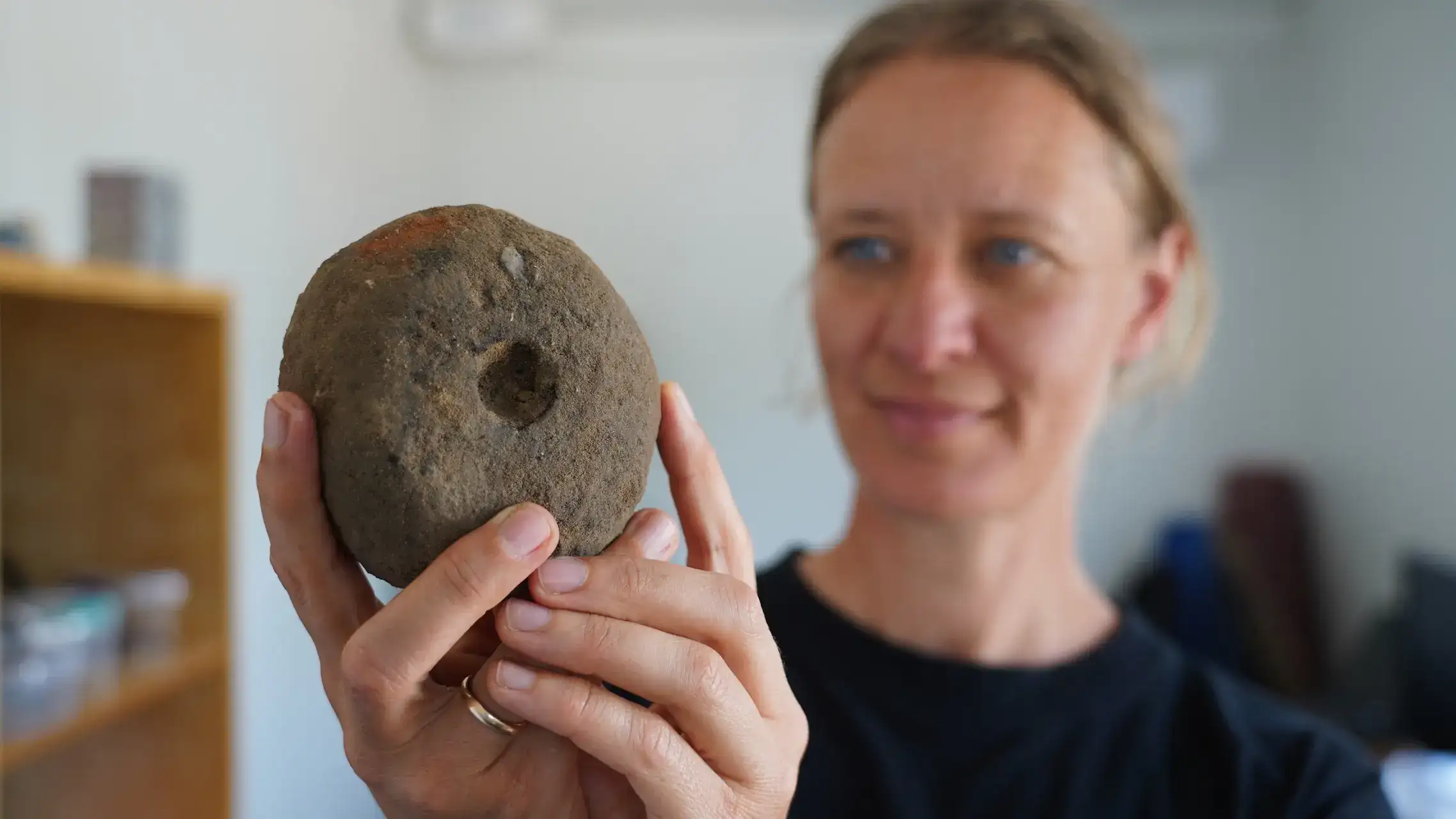
The discoveries extended beyond buildings. The team recovered spindle whorls used for spinning fibers into thread and loom weights that kept weaving threads in place. Other finds included silver coins, pearls, beads, pottery, scissors, a knife and a key.
Future studies, including carbon dating and pollen analysis, are expected to provide further details about the precise nature of textile production in the area, as per a report by Smithsonian magazine.
How did the site connect to international trade?
During the Viking Age, Aarhus, then known as Aros, served as both a royal center and a commercial hub linking Scandinavia with distant regions.
Researchers believe settlements such as Søften supplied goods that were transported into Aarhus before reaching wider markets.
“When you have a production site of this scale, it cannot be only because of the local area,” Andersen tells the AP. “It needs to be understood as part of a greater network, a much bigger international perspective.”
The discovery therefore strengthens evidence that Viking communities participated in organized trade systems that stretched far beyond their immediate surroundings.
The region around Aarhus has yielded several significant discoveries in recent years. In Lisbjerg, archaeologists uncovered a major Viking Age burial site containing 30 graves. Some included valuable items such as ceramics, coins, pearls, gold thread and scissors, indicating that individuals of considerable status were buried there, while simpler graves may belong to enslaved people.
Researchers have linked those burials to a large estate discovered during the late 1980s. The property may have belonged to a nobleman who served under Harald I, ruler of Denmark and parts of Norway between approximately 958 and 985 C.E.
Archaeologist Liv Stidsing Reher-Langberg of the Moesgaard Museum previously told Live Science that the estate owner likely “had enormous power—economically, politically, religiously and socially.”
Additional evidence of regional commerce emerged in 2024 when an archaeology student found seven silver bracelets in nearby Elsted. Dating to around the ninth century, the items may have functioned both as jewelry and as a form of payment.
Taken together, the discoveries from Søften, Lisbjerg and Elsted continue to reveal a Viking society defined not only by exploration and warfare but also by production, commerce and complex social organization.
FAQs
Where was the Viking textile site discovered?
It was found in Søften, near Aarhus in Denmark.
What does the discovery suggest about Vikings?
It points to a highly organized society connected to larger trade networks.