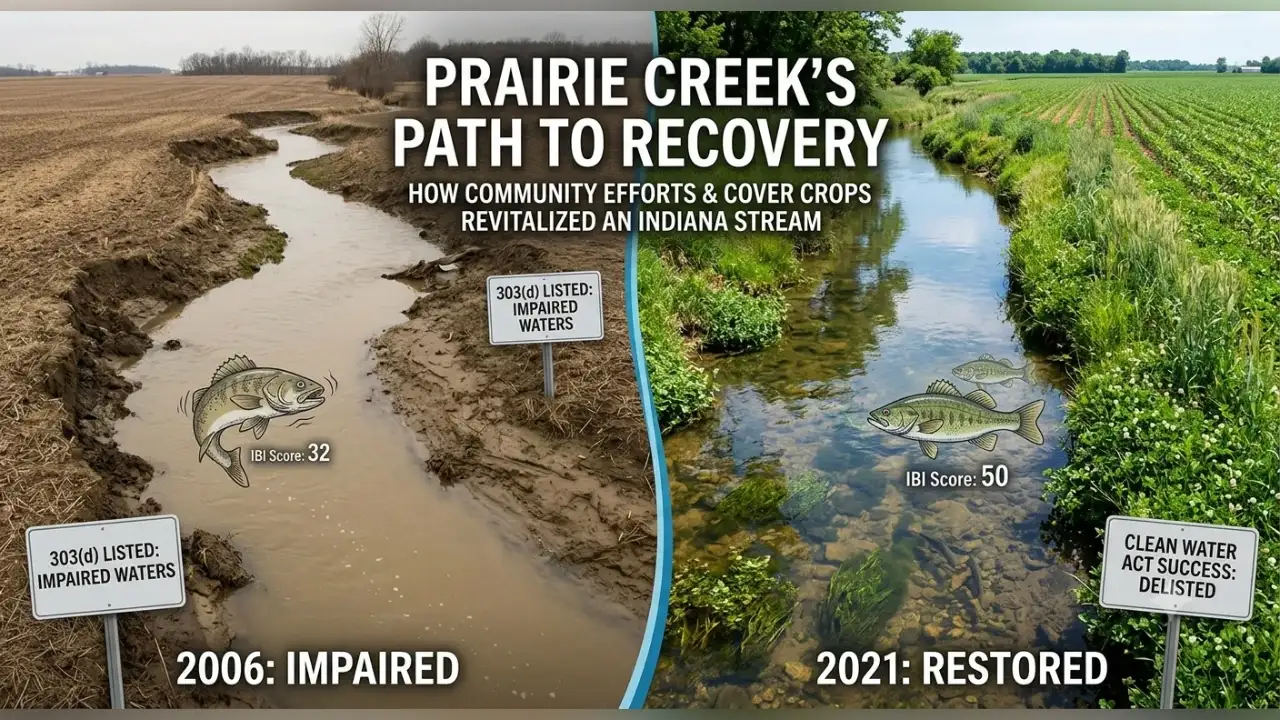
Prairie Creek in Indiana was once considered unable to support healthy aquatic communities. In 2006, the state added the stream segment to its Clean Water Act Section 303(d) List of Impaired Waters for impaired biotic communities.
A watershed management plan completed in 2012 led to agricultural and urban improvements across the South Fork Wildcat Creek watershed. Cover crops were among the main practices implemented on or near Prairie Creek.
Nine years later, IDEM's performance monitoring showed that Prairie Creek had an Index of Biotic Integrity score of 50, making it eligible for removal from the impaired waters list.
A low fish-community score led to the impairment listing
Prairie Creek is a 6.69-mile stream segment that flows northwest toward the city of Frankfort.
Fish sampling conducted during IDEM's 2004 study of the South Fork Wildcat Creek watershed gave the monitoring site an Index of Biotic Integrity score of 32. In Indiana, a score below 36 indicates that a stream is not supporting aquatic communities.
The results contributed to Prairie Creek being listed as impaired for biotic communities in 2006.
The 2012 watershed plan led to new projects
IDEM provided funding in 2009 for the development of the South Fork Wildcat Creek Watershed Management Plan, which was completed in 2012.
After the plan was completed, the Clinton County Soil and Water Conservation District began implementing the South Fork Wildcat Stewardship Initiative.
The first phase included 50 water-quality improvement projects across the watershed. The projects involved agricultural and urban best management practices, while five urban projects included a rain garden, bioswale, conservation cover, pervious pavement and underground storage.
Additional Section 319 funding supported a second phase beginning in 2017, which included 30 agricultural best management practices, most of them involving cover crops. A third phase received funding in 2021 and was still in progress.
Cover crops helped reduce sediment loads
Most of the best management practices on or near Prairie Creek involved cover crops.
During the first phase of the stewardship initiative, cover crop implementation reduced total suspended solids by an estimated 5,695 tons per year. During the second phase, the reduction was estimated at 7,027 tons per year.
The reduction in suspended sediment likely contributed to improvements in the creek's fish community. Suspended sediment can clog fish gills, inhibit growth, decrease resistance to disease and interfere with proper egg and larval development.
Prairie Creek met the standard for removal
IDEM's 2021 performance monitoring recorded an Index of Biotic Integrity score of 50 for Prairie Creek, compared with 32 in 2004.
The Qualitative Habitat Evaluation Index score at the monitoring site also increased from 49 in 2004 to 52 in 2021.
The improved biological conditions made Prairie Creek eligible for removal from the Clean Water Act Section 303(d) List of Impaired Waters, and IDEM removed the stream segment from the list.