
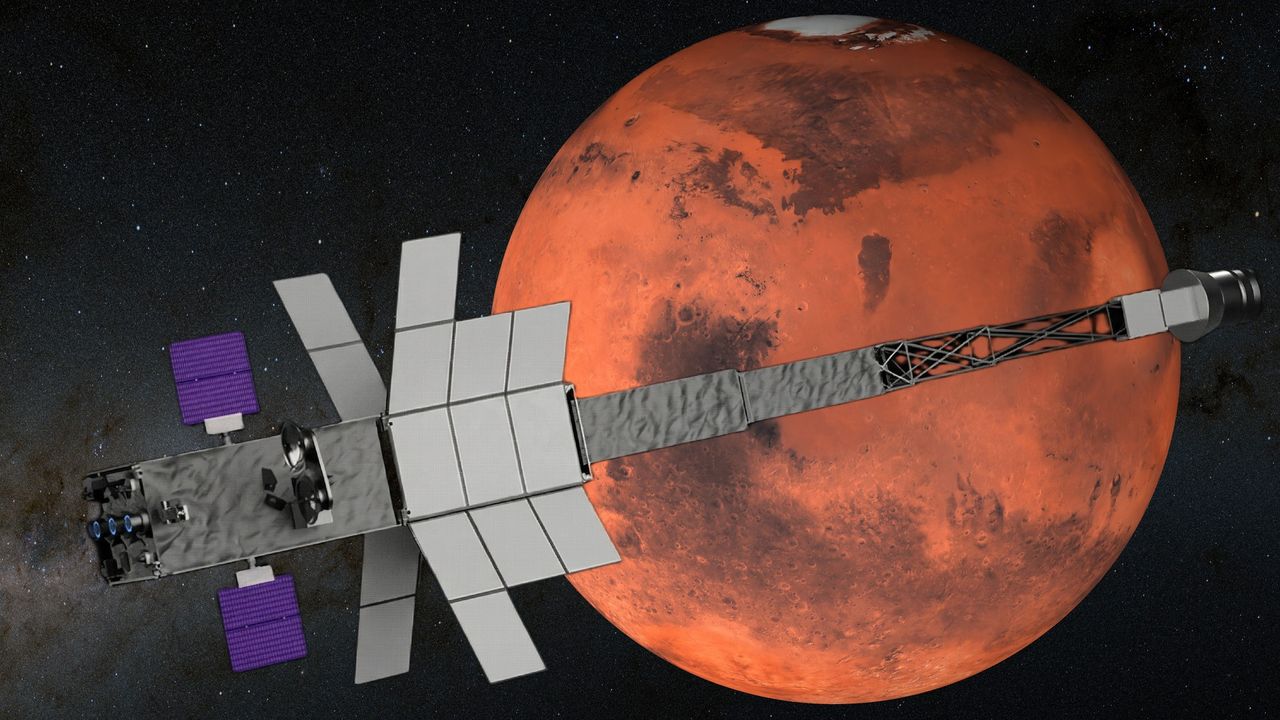
Skyfall is happening, and it will get to Mars in a totally new way.
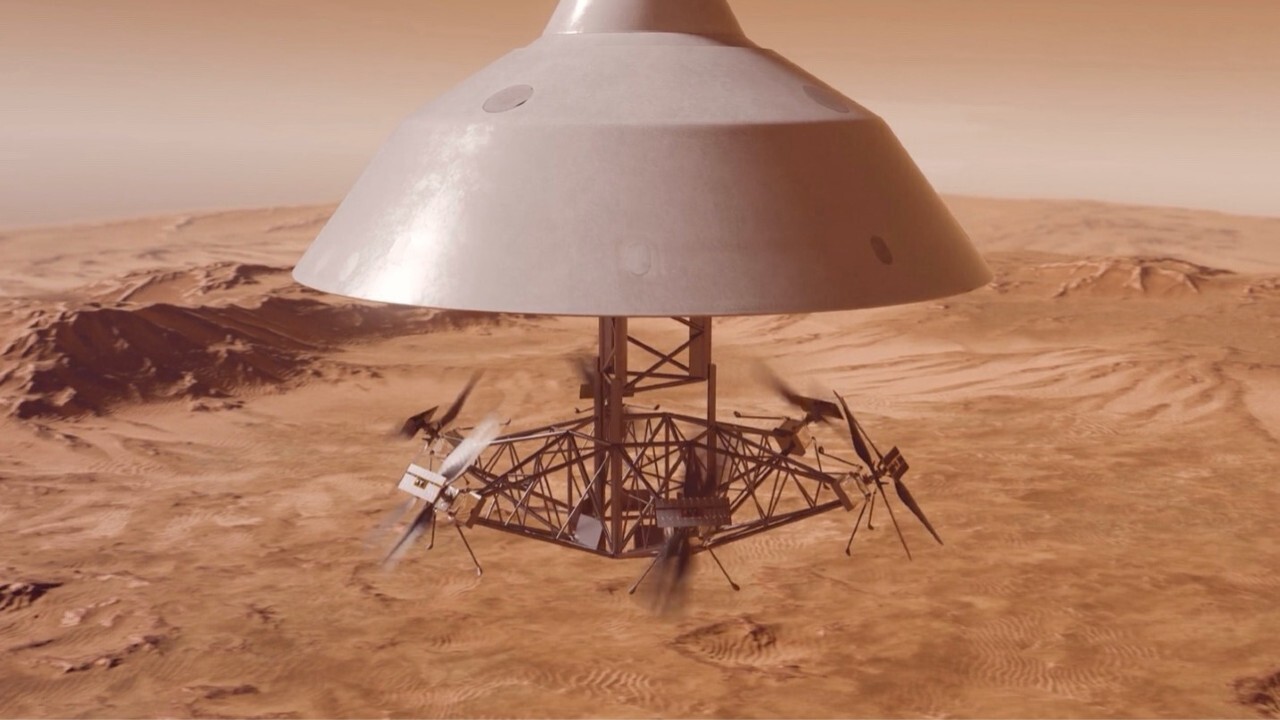
Last summer, NASA's Jet Propulsion Laboratory and the Virginia company AeroVironment unveiled their Skyfall mission concept, which would send a fleet of tiny helicopters to explore the skies of Mars.
Today (March 24), NASA announced that it will develop Skyfall for a 2028 launch, and that the mission will journey to the Red Planet on a spacecraft that uses nuclear electric propulsion (NEP) — what NASA is referring to as "the first nuclear powered interplanetary spacecraft."
NEP systems operate like nuclear power plants here on Earth, relying on an onboard fission reactor. NEP is a fundamentally different technology than radioisotope thermoelectric generators (RTGs), which have powered the instruments of NASA deep-space probes like Voyager for decades. RTGs use the heat of radioactive decay to generate electricity; they are not involved in propulsion.
"Requiring operating temperatures less than nuclear thermal propulsion, the thermal energy produced by the reactor generates electricity, which is then used to power highly efficient electric thrusters," NASA officials wrote in a description of the agency's NEP efforts.
NASA views NEP tech — which can operate at all distances from the sun — as key to its future exploration efforts, from robotic missions to the outer solar system to the operation of a moon base via its Artemis program.
So the centerpiece of the Skyfall mission may not be its fleet of Mars helicopters but rather their interplanetary ride — a spacecraft called Space Reactor-1 (SR-1) Freedom.
"SR-1 Freedom will establish flight-heritage nuclear hardware, set regulatory and launch precedent, and activate the industrial base for future fission power systems across propulsion, surface and long‑duration missions," NASA officials said today in a statement announcing the mission.
"NASA and its U.S. Department of Energy partner will unlock the capabilities required for sustained exploration beyond the moon and eventual journeys to Mars and the outer solar system," they added.
That statement features a wealth of other exploration news and updates. For example, NASA also announced today that it's pausing its long-planned Gateway moon-orbiting space station to focus on building a base on the lunar surface — and some of Gateway's hardware will go into the construction of that outpost.
That statement doesn't reveal many details about the planned Skyfall mission, but NASA revealed some during a webcast presentation today.
For example, Skyfall will feature three little helicopters, which will be similar to Ingenuity, the NASA rotorcraft that landed on the Red Planet with the Perseverance rover in February 2021. Ingenuity became the first helicopter ever to operate on a world beyond Earth, making a whopping 72 flights between April 2021 and January 2024.
Whereas Ingenuity was a technology demonstrator, however, the Skyfall fleet will have concrete tasks. Chief among them is scout: If all goes to plan, the little choppers will help NASA assess the potential of their target area (wherever that happens to be) to support human exploration.
The Skyfall helicopters will carry cameras and ground-penetrating radar to scout a future landing site, to understand the slopes and hazards for human-scale landers," Steve Sinacore, the program executive for NASA's Space Reactors Office, said during the briefing.
"They will also map and characterize the subsurface water ice to find out where the water ice deposits are, along with the size, depth and other important characteristics," he added.
If goes according to plan, the mission will launch in December 2028 and arrive at Mars about a year later. And that might not be the end of the line for SR-1 Freedom; NASA may decide to keep flying the spacecraft out into the solar system after it deploys the Skyfall choppers, according to Sinacore. The mission architecture, like much of NASA's exploration portfolio, is not yet finalized.
Editor's note: This story was updated at 7:45 p.m. ET on March 24 with more details about the mission from Sinacore's March 24 presentation.