
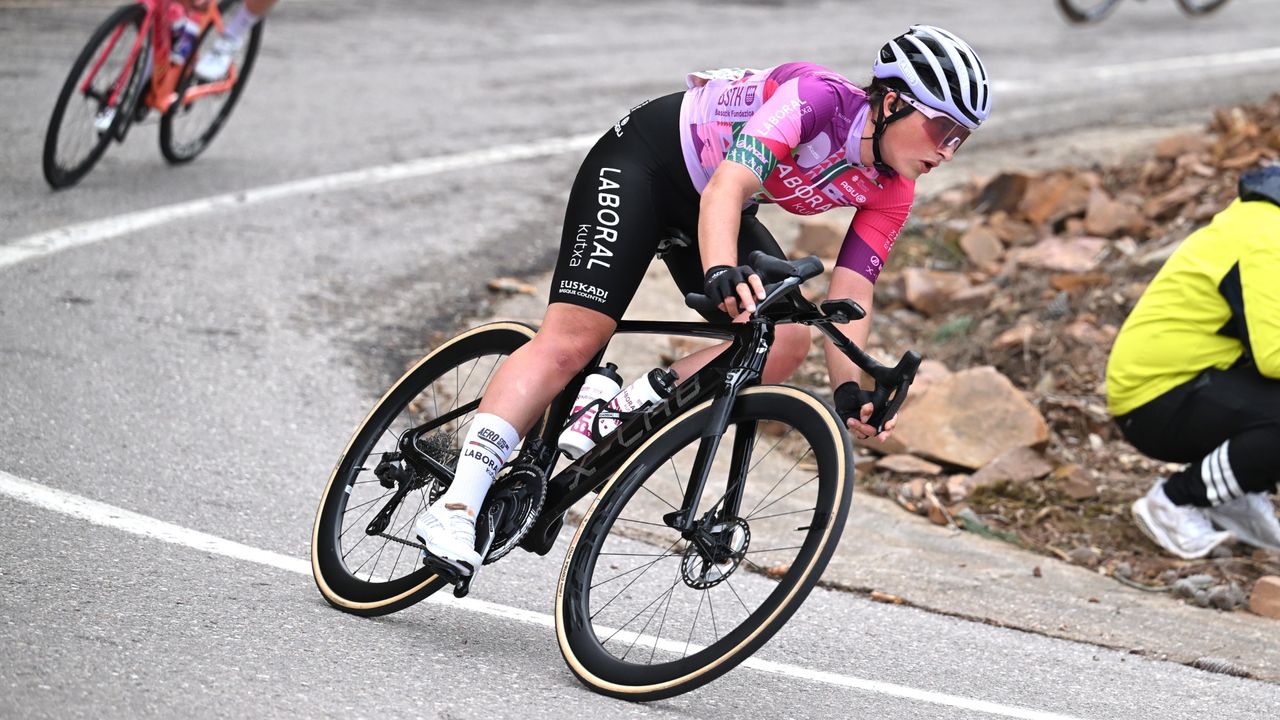
Over the weekend, Debora Silvestri (Laboral Kutxa - Fundación) suffered a horrific crash at Milan–San Remo Donne.
It happened, as these things so often do, in a place that invites chaos: the descent off the Cipressa, a road full of blind corners where riders push the limits of speed and control. Brake a fraction too late, touch a wheel, hesitate for half a second. It doesn't take much for a courageous performance to turn into a disastrous one.
Kasia Niewiadoma-Phinney was the first to hit the barriers, and those behind her followed. Silvestri, coming around the blind corner at speed, was catapulted off her bike, somersaulting over the barrier before coming to a hard, motionless stop on the road below.
The footage circulated instantly. Different angles, slowed down, zoomed in, shared and reshared.
It was a horrible crash. Probably the worst I can recall watching live since Annemiek van Vleuten’s fall at the Rio Olympics in 2016. But it was not an unusual one.
Crashes are an unfortunate but entirely ordinary part of cycling. More often than not, riders pick themselves up and carry on, bloodied, bruised, torn kit and all. As Kim Le Court, one of the riders caught up in the crash, put it succinctly: "That’s bike racing." Not women’s bike racing. Bike racing. Full stop.
On Saturday, the men raced the same race, over many of the same roads, with the same risks. And here too, crashes (some minor, some race-ending) were scattered across 300 kilometres of attrition. Even the eventual winner, Tadej Pogačar, hit the deck before getting back on and winning anyway.
That is cycling. It always has been.
Yet only one of those crashes seemed to invite a broader discussion about who belongs on a bike. In men’s racing, crashes are framed as risk, positioning, bad luck and the inevitable consequence of racing on the limit. Yet Silvestri’s crash became something else entirely once it left the broadcast and entered the comment sections.
"To busy thinking about the kitchen.”
"Women fall like 80 year old lady's"
"And this is why you should stay in the kitchen."
Groan.
We’ve seen these before. And we will see them again. The comments are unimaginative, repetitive and, often, barely literate. They hardly seem worth engaging with. And yet they are common enough that there is research on exactly this pattern.
Studies of sports media and audience perception show that women athletes are more likely to be framed in terms of inherent ability or, rather, limitations, while men’s performances are contextualised through tactics, conditions or circumstances. In other words, when a man crashes, it’s the race; when a woman crashes, it becomes something about women.
Research on online abuse in sport has also found that sexist commentary spikes around high-visibility incidents like crashes, injuries or mistakes. The spectacle becomes a trigger, and the reaction is not analysis but regression: a snap back to tired assumptions about fragility, competence and whether women should be there at all.
And then there is a more subtle layer. Psychology research has shown that people tend to feel greater compassion and protective concern when women are hurt than when men are, a phenomenon sometimes described as a "gender empathy gap." But that empathy is not neutral. It is tied to the perception of women as more vulnerable, more in need of protection and therefore, implicitly, less suited to risk. What presents itself as concern easily slips into paternalism. Not "that was dangerous" but "this is too dangerous for women."
There is no meaningful evidence that women’s cycling is more crash-prone than men’s. The variables are the same: speed, proximity, terrain, risk. The outcomes are the same, too. Silvestri broke five ribs and suffered a minor shoulder fracture in that fall.
That is the story. Not some discussion on women’s bike handling. Not a cautionary tale about participation. Just a rider who hit the deck in a race that has been knocking riders off their bikes for more than a century.
If there is anything remarkable here, it is not the crash itself, but the response, which says far more about the viewer than the sport. Though honestly, even the misogyny is getting tedious at this point.
The only correct response to the crash is a simple one: Heal up, Debora.