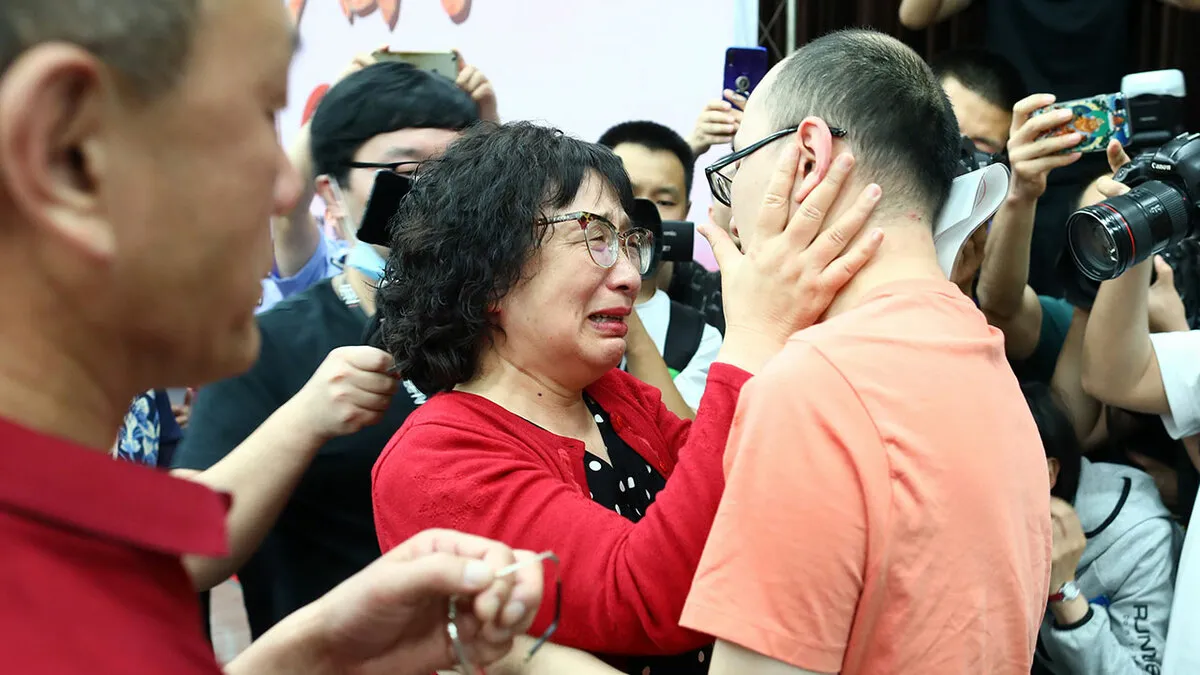
Nearly 1 million children go missing every year all across the globe. That’s nearly 1 million kids who end up in unfamiliar places, surrounded by unknown people and frightening circumstances. It’s enough to traumatize an adult, let alone a child. Li Jingzhi, a woman from Shaanxi Province in northwest China, lived through the unimaginable experience of losing her son. She was a mother without her child for 32 years. Unfortunately, at the time, China was experiencing a surge in child abductions, and Jingzhi was one of many parents who had their child taken from them during a difficult period in the country’s history. "[Economic modernization] will be impossible unless the peasants have fewer children,” said Deng Xiaoping, the paramount leader who implemented the one-child policy in 1979, cited as one of the reasons for the kidnappings. But Jingzhi’s relentless search happened after an ordinary day in Xi’an, the capital of Shaanxi, where she lived with her then-husband, Mao Zhenjing, and their beloved toddler, Mao Yin. And all it took was a trip to the family-owned hotel for their lives to change forever. Curated Lifestyle / Unsplash (not the actual photo) The story begins in 1988, in Xi’an, China. Li Jingzhi and her husband, Mao Zhenjing, had one child, Mao Yin, whom his mother nicknamed Jia Jia, meaning “great.” And judging by the expectations they had for their only child, the nickname certainly fit. They spoiled him and loved him with all their hearts. At the time, China’s one-child policy was in effect. Introduced in 1980 and lasting until 2016, the policy meant most families could have only one child, in an effort to curb population growth that was pressuring food supplies. There were some exceptions, including for certain rural families whose first child was a girl, allowing them to try for a son to carry on the family name. Jingzhi and Zhenjing were considered lucky at the time: first try, one son. As a result, the parents wanted to give Jia Jia the best possible chance at life. From trips to the zoo to daily playtime with his mom, he was loved and cared for in the way every child should be. But tragically, that all came to an abrupt end one ordinary day when Jingzhi, who worked at a grain-exporting company, had left for a few days during harvest season. Then she received a daunting telegram with just a few words: “Emergency at home.” CYOL While Jingzhi worked in the countryside, Jia Jia stayed home with his father, and for two years, everything had gone smoothly. So when she suddenly received the telegram urging her to “return right away,” she panicked, with no idea what fate had in store for her. “I didn’t know what had happened,” she later told the BBC. When she hurried back to Xi’an, a manager told her that her son, Mao Yin — her beloved Jia Jia — was missing. “My mind went blank,” she recalled. “I thought perhaps he had got lost. It didn’t occur to me that I wouldn’t be able to find him.” At the time, the toddler was just two years and eight months old. But once she reunited with her husband, the full story began to unfold. Zhenjing explained that after picking up their son from kindergarten, the two stopped at their family-owned hotel to get Jia Jia a cup of water. While he retrieved the drink and cooled it down, he turned his back for a minute. That was all the time it took for the toddler to disappear from his sight. Inside their own family-owned hotel. According to statistics, more than 99% of missing children are eventually found alive and returned safely to their homes. Often, they are found within hours or days, especially today, with systems like AMBER Alerts and digital tracking helping authorities locate missing children. But back then, none of those tools existed. Still, Li Jingzhi and her husband held on to hope that finding their son was only a matter of time. South China Morning Post / YouTube What they didn’t know was that China was entering a period of rising child abductions. At the time, the issue was heavily underreported, and there is no definitive official government statistic showing exactly how many children were abducted. However, available databases and estimates suggest that tens of thousands of children were kidnapped and sold during that decade alone. The era was especially difficult for families who lost children and were never able to reunite with them. The One-Child Policy, combined with strict birth quotas and a cultural preference for sons, contributed to the creation of a black market for children. Families who couldn’t have another child sometimes turned to illegal adoptions, thus resorting to these underground means. However, the young parents were unaware of the scale of the problem. Police forces also lacked the databases, technology, and infrastructure needed to effectively track missing children, especially when they were taken to other regions. So the family was largely left to fend for themselves. Initially, Li Jingzhi believed her son “was lost and couldn’t find his way home,” and that eventually, “kind-hearted people would find him and bring him back.” She never even expected that the missing children notices she saw on television were kidnappings. “I never thought they [the notices] had been abductions, especially of boys. I just thought they were lost.” But after a week with no leads, the mother decided to take matters into her own hands. She printed 100,000 flyers with Jia Jia’s photo and distributed them throughout Xi’an, putting them up wherever she could think of: railway stations, bus stations, and even local newspaper advertisements for missing people. Nothing came of it. Cultination1 / X “My heart hurt… I wanted to cry. I wanted to scream. I felt as though my heart had been emptied,” said Jingzhi. That same year, the couple received what seemed like a promising lead. After weeks and months of searching, Jingzhi learned that a couple in a town in Shaanxi had adopted a boy who looked eerily similar to Jia Jia. So she traveled there to find them, only to discover that the couple had already gone to Xi’an. She returned home, but she refused to give up. After hours of searching, she learned that the couple had moved on to another city. Once again, she set out to track them down. After two days of barely sleeping or eating properly, however, the exhausted mother finally decided to rest. It turned out to be the right decision because she eventually found the woman and the child — but it wasn’t Mao Yin. Once again, she was back where she started. “I thought for sure this child was Jia Jia. I was very disappointed. It had a huge impact on me. Afterward, I kept hearing my son’s voice. My mum was worried I would have a mental breakdown,” Jingzhi admitted. The grief eventually took its toll. At first, Jingzhi said she blamed her husband for what had happened. But they eventually agreed to set their differences aside and work together relentlessly to find their son. Four years later, however, with few leads and no sign of Jia Jia, the couple divorced. They couldn't overcome the pain and grief that came with not knowing where their son was. BBC As time passed, Jingzhi realized that Jia Jia’s case was far from the only one. So, she began contacting other parents whose children had gone missing. Together, they formed a network that eventually spanned most provinces in China. They shared notices and flyers, followed leads, and worked together to help as many families as possible. But none of those leads brought Jia Jia home. After 19 years of searching, the mission had become more than just a desperate search for her own son. It had become a passion project. Then Jingzhi discovered “Baby Come Home,” a new Chinese organization and volunteer network dedicated to finding missing and abducted children and reuniting them with their families. Founded in 2008 by a couple, the organization gave Jingzhi a new place to continue her search. There, she found something she had been missing for years: a support system. “I no longer felt lonely. There were so many volunteers helping us find our children,” she said. And her mission had changed, too. She now wanted to help other children return home. “I thought even if my child is not found, I can help other children find their home.” Two years later, the Chinese government introduced another major tool in the fight to reunite missing children with their families: a nationwide DNA database. Parents who had lost their children could register their DNA, allowing authorities to compare it against DNA collected from unidentified or missing children. The system eventually helped solve thousands of cases. Over the years, Jingzhi personally helped 29 children reunite with their parents. Yet every reunion came with a bittersweet reminder of what she was still missing. “I would ask myself: ‘Why couldn’t this be my son?’ But when I saw the other parents hugging their child, I felt happy for them. I also felt that if they could have this day, I definitely could have this day too. I felt hopeful,” she shared. STR / AFP In 2015, Jingzhi’s mother passed away at the age of 94. On her deathbed, the older woman told her daughter that she had dreamed Jia Jia had come home. “It’s been nearly 30 years. He should return,” she told her. She passed away on January 15, 2015. Jia Jia’s birthday. For Jingzhi, it only reinforced what she already knew: she could not and would not give up searching for her son. Then, months later, she received an unexpected call. It was May 10, and that year, it was Mother’s Day in China. On the other end of the line, the Public Security Bureau told her the words she had been waiting three decades to hear: “Mao Yin has been found.” It all began with a lead from the month before. Someone had given Jingzhi a photograph of a man taken from Xi’an years earlier, and she immediately became hopeful. She took the photo to the police, who used facial-recognition technology to search for a match. The system identified a man living in Chengdu, Sichuan Province, roughly 700 kilometers from Xi’an. The police got to work. They eventually convinced the man to provide a DNA sample, and on May 10, the results came back: It was a match. “It was when I got the DNA results that I really believed that my son had really been found,” Jingzhi said. Over 32 years, she followed more than 300 false leads. Then, on May 18, 2020, the mother and son finally reunited. Eight days after the discovery. But before the meeting, Jingzhi was terrified. SINA “Before the meeting, I had a lot of worries. Perhaps he wouldn’t recognize me, or wouldn’t accept me, and perhaps in his heart he had forgotten me,” she said. “I was very afraid that when I went to embrace my son, my son wouldn’t accept my embrace. I felt that would make me feel even more hurt, that the son I had been searching for, for 32 years, wouldn’t accept the love and hug I gave him.” Thankfully, those fears weren't true. China Central Television broadcast the reunion live. With Mao Yin’s father also present, the three ran into each other’s arms and wept for all the time they'd missed. After 32 years of searching, the family was finally together again. But there was still much to learn about what had happened to Jia Jia. According to information released after the reunion, Mao Yin had been sold to a childless couple in Sichuan for 6,000 yuan, equivalent to around $840 today, about a year after his abduction. The couple gave him a new name, Gu Ningning, and he eventually attended college in Chengdu. A heartbreaking coincidence was also shared: Mao Yin had seen Jingzhi on television before their reunion. He thought the woman speaking about her missing son seemed warm and kind. Even when he saw his own childhood photos on the news, he never realized the little boy in those pictures was him. BBC After reuniting, the family had a lot to catch up on. Unfortunately, Mao Yin had little to no recollection of his earliest years, only remembering the life he had shared with his adoptive parents. “After my son came back, he also wanted to find an image or memory of the life he had when he was still with me,” Jingzhi said. “But as of now, he still hasn’t found it.” Despite the pain of a child who doesn't remember their mother, Mao Yin decided to spend a month in Xi’an, where he and his biological parents could create new memories together. “I felt that if he could return to my side, we could start all over again from when he was a child. We could fill this 32-year gap,” his mother shared. However, after their time together, Jia Jia returned to Chengdu while his mother remained in Xi’an. After 32 years of searching, with love and heartbreak in between, Jingzhi understood that her son now had a life of his own. “He’s a grown-up now. He has his own way of thinking. He has his own life. Jia Jia has got married and has his own family. So I can only wish him well, from a distance. I know where my son is. I know he’s still alive. That’s enough.” And perhaps, after 32 years of searching, that was all Jingzhi needed to know. Now, she can finally rest with a lighter heart, knowing that her son is alive, well, and living his own life. Ксения / Pexels (not the actual photo)